If you were raised in Christianity or another Abrahamic tradition, you probably did not first encounter the word demon as a neutral description of a spirit.
It came with baggage.
Hell. Satan. Temptation. Possession. Evil. Spiritual danger.
That is where confusion about demons in witchcraft often begins.
So encountering witches who openly discuss demonology, grimoires, infernal spirits, or even working with beings called demons can create an understandable moment of confusion:
Wait. If witchcraft isn’t Christianity, why are Christian demons showing up here at all?
The answer is less about one universal definition of witchcraft and more about the complicated history of magic, religion, folklore, and the many ways human beings have understood spirits.
Witchcraft Is Not One Religion
One of the easiest assumptions to make is that witchcraft has a single theology.
It does not.
Witchcraft is better understood as a broad family of magickal practices, traditions, identities, and spiritual approaches. A witch may be Pagan, Christian, Jewish, atheist, animist, polytheist, agnostic, eclectic, or something that does not fit neatly into any of those categories.
Some witches work primarily with plants and folk remedies. Others focus on divination, ancestors, spirits of place, deities, astrology, ceremonial magic, or personal ritual.
And yes, some witches explore demonology & demons in witchcraft.
That does not mean demonology is inherently part of witchcraft. It simply means that the worlds of witchcraft and Western occultism have crossed paths many times.
The Abrahamic Demon Is Only One Kind of “Demon”
For those of us raised with Christian imagery, the story we absorbed may have seemed straightforward:
God & heaven.
Satan & hell.
Demons associated with evil, temptation & spiritual danger.
But this is not the only way spirits called demons have been understood.
The English word demon ultimately traces back to the Greek daimōn, a term that could refer to a supernatural being, lesser divinity or spiritual presence. Unlike the later Christian understanding of a demon, a Greek daimōn was not inherently evil.
Over centuries, religious traditions changed how certain spirits were categorized. As Christian theology developed, the category of the demon became much more specifically associated with evil spirits. That shift in meaning is part of why the same or related spiritual language can carry very different assumptions depending on the tradition using it.
That history matters because modern occultists do not all use the word demon in the same theological sense.
Depending on the practitioner, a “demon” might be understood as:
- a hostile spiritual being,
- a powerful but morally complex intelligence,
- an archetype or psychological symbol,
- a spirit later interpreted through Christian demonology,
- or something they simply choose not to engage with.
A shared word does not necessarily mean a shared theology.
A Quick Vocabulary Guide
Demon: A term whose meaning has changed across religious, historical & occult traditions. In Christian theology, it generally refers to an evil spirit, but that meaning should not automatically be projected backward onto every older use of related terms.
Daimōn: An ancient Greek term that could refer to a supernatural being, lesser divinity or intermediary spiritual presence. A daimōn was not inherently equivalent to the later Christian concept of an evil demon.
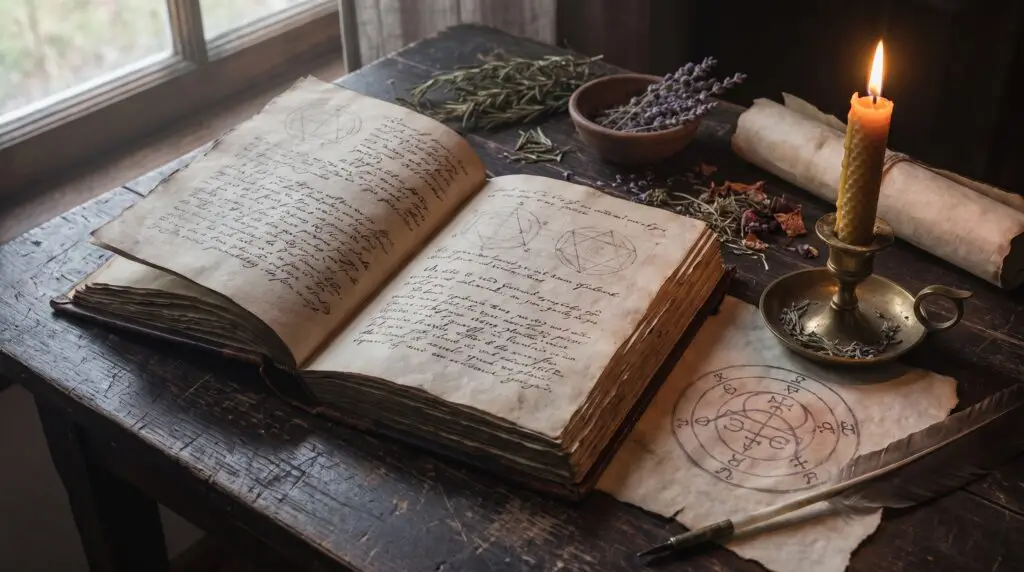
Grimoire: A practical book of magick that may contain rituals, prayers, seals, charms, invocations or instructions for working with spiritual beings.
Demonology: The study, classification or theology of demons & related spirits.
Demonolatry: The worship or veneration of beings understood as demons. Modern practitioners vary considerably in how they understand demons in witchcraft.
Solomonic magic: A broad term for later magickal traditions & texts associated with King Solomon, particularly traditions involving divine names, angels, spirits, seals & ritual conjuration.
The Strange World of Solomonic Magic
One of the clearest places where Abrahamic religion and occultism intertwine is the magickal tradition associated with King Solomon.
In the Hebrew Bible, Solomon is remembered primarily as a king renowned for wisdom and for building the First Temple in Jerusalem. His later reputation as a magician & commander of spirits comes from traditions that developed beyond the biblical accounts.
In later texts such as the Testament of Solomon, Solomon becomes a master of spirits who commands demons through divine authority. His reputation as a magician continued to develop, eventually producing a broad tradition of magickal works attributed to his name.
These traditions can look very strange from a modern perspective.
The magician might invoke the names of God, call upon angels, use biblical language, draw magickal seals, and command demons, all within the same ritual universe.
One reason demonology appears in Western magick partly because Western learned magick developed through a long exchange among Greek, Roman, Jewish, Muslim & Christian traditions.
The occult did not grow outside religion.
It grew alongside it, underneath it, and sometimes directly through it.
Demonology and Demonolatry Are Not the Same Thing
This is also where two words that sound very similar start causing confusion: demonology & demonolatry.
Demonology, in its broadest sense, is the study or classification of demons and related spirits. Historically, Christian theologians practiced demonology. Medieval and early modern writers produced elaborate theories about demons, their hierarchies, their abilities, and their relationship to human beings.
Demonolatry literally refers to the worship or veneration of demons, although modern practitioners vary considerably in what they mean by “demon” & how that relationship is understood.
That distinction matters. Someone discussing the history or classification of demons is not necessarily worshipping, venerating, invoking, or working with them.
Some modern demonolators do not see these beings as evil.
They may regard them as gods, ancient spirits, teachers, intelligences, or powerful entities worthy of respect rather than enemies to be banished.
This is one reason conversations about demons in witchcraft can become confusing very quickly.
Two people may use the same name for a spirit while holding completely different beliefs about what that spirit actually is.
But What About Hell?
This is where many people with Abrahamic backgrounds feel the greatest disconnect.
If demons come from hell, and a witch does not believe in hell, how can the witch believe in demons?
The answer is that many practitioners reject the premise that demons must come from a Christian hell.
Some understand hell symbolically. Others believe in multiple spiritual realms, view spirits as existing independently of Christian theology, or understand demonological literature as one culture’s interpretation of much older spiritual ideas.
In other words, the name may remain while the theology changes.
This happens frequently in religious history. Cultures inherit names, symbols, stories, and spirits from one another, then reinterpret them according to new worldviews.
Occult traditions are no exception.
You Don’t Have to Work With Demons
Understanding why demons appear in Western occult traditions does not mean you have to make them part of your own practice.
You do not have to work with demons in witchcraft practices to be a witch.
You do not have to work with spirits at all.
Consequently, that may be especially important to hear if you were raised in a religious environment where demons, spiritual danger, sin or punishment were strongly emphasized. Those ideas can remain emotionally powerful even after your beliefs begin to change.
Therefore, someone may no longer believe intellectually in eternal damnation & still feel a visceral reaction to certain names, symbols or ideas.
That discomfort does not need to become a test you must pass.
There is no spiritual graduation ceremony in which a witch eventually becomes advanced enough to begin summoning infernal kings.
A complete magickal practice might involve growing herbs, observing the seasons, reading tarot, practicing protection magic, keeping a dream journal, making charms, working with candles or simply cultivating a deeper relationship with the natural world.
Curiosity does not require participation.
You could study demonology historically without practicing it. It’s possible to explore where your inherited fears came from without deciding they were foolish. You can decide that certain magickal traditions simply do not belong in your personal path.
Demonology is one branch of a very large & very old tree.
It is not the trunk.
Mythos, Magick, and the Importance of Context
Perhaps the most useful lesson demonology offers the modern witch is not about demons at all.
It is about context.
Words such as witch, demon, spirit, god, angel, and magick have never had only one meaning.
They have traveled across languages, cultures, religions, political struggles, folklore, and centuries of changing belief.
When we encounter an occult tradition that feels strange or contradictory, it is often worth asking:
Whose definition am I using?
When You Encounter Demonology Online, Ask:
- What tradition is this person speaking from? Christian demonology, ceremonial magic, demonolatry & modern witchcraft do not begin with the same assumptions.
- What do they mean by the word demon? Do they mean an evil spirit, a deity, an intelligence, an archetype, a literary figure or something else?
- Are they describing history, theology, personal belief or personal experience? Those are not interchangeable forms of evidence.
- Are they presenting their cosmology as though every witch shares it? No single occult framework speaks for all witchcraft.
- Does this actually belong in my practice? Understanding a tradition does not obligate you to adopt it.
A demon in medieval Christian theology is not necessarily the same thing as a Greek daimōn.
A demon in a Renaissance grimoire is not necessarily understood the same way by a modern demonolator.
And none of those definitions necessarily belong in your own witchcraft practice.
The magickal world is much larger than any single cosmology.
Sometimes wisdom begins not with deciding what a spirit must be, but with understanding the many stories human beings have told about it.
And from there, we decide which stories belong at our own hearth.