Imagine being challenged to approach a corpse hanging from a gallows on a cold autumn night.
You accept the challenge, venture into the darkness & discover that the dead man has something to say.
And apparently, he’s thirsty.
What happens next involves supernatural encounters, an entire fortress destroyed, a journey into another world & time behaving in ways it simply shouldn’t.
Welcome to one of the strangest stories associated with Samhain (roughly pronounced SOW-in).
Long before glowing pumpkins filled American porches, medieval Irish storytellers were describing a night when ordinary reality could become terribly unpredictable.
The dead might speak. The hills might conceal entrances to another realm. Even the familiar landscape could become something dangerous after sunset.
Today, Samhain is celebrated by many witches, Pagans & nature-centered spiritual practitioners as a time of remembrance, divination, ancestor work & seasonal transition.
But how much of what we associate with Samhain actually comes from historical tradition? Why do some practitioners celebrate on October 31 while others insist the astronomical date falls in November? And what does observing Samhain look like if you’re just beginning to explore witchcraft?
There’s a lot more to this festival than the familiar claim that the veil between worlds grows thin.
And some of it is wonderfully strange.
The Night Nera Met a Talking Corpse
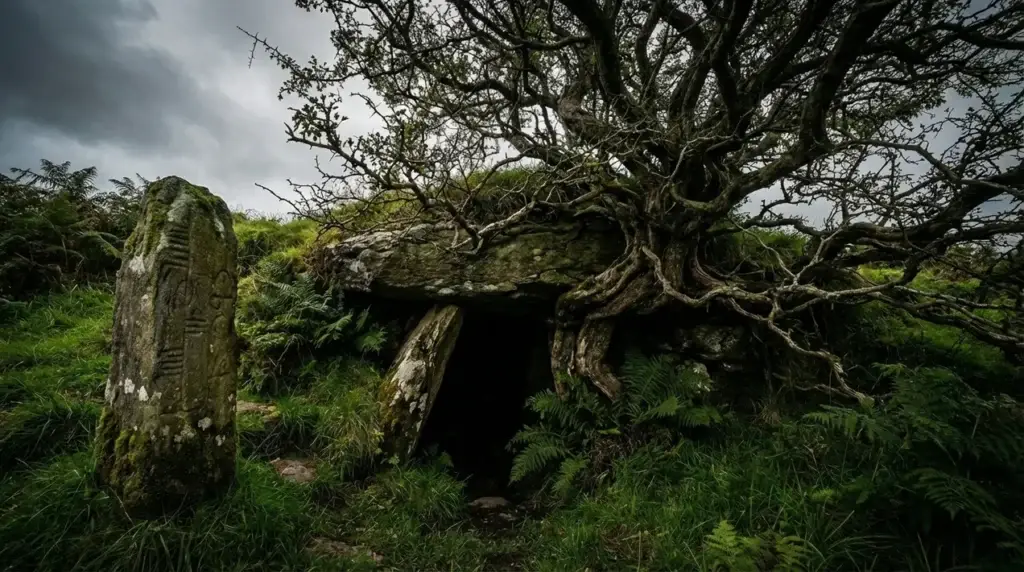
The story begins at Rathcroghan, an ancient royal center in Ireland that features prominently in Irish mythology.
In the medieval tale The Adventure of Nera, King Ailill, Queen Medb & their household are gathered for Samhain.
Outside the fortress, two executed prisoners hang from a gallows.
The king offers a reward to anyone brave enough to venture into the darkness & fasten a loop of woven material around one of the corpses.
This is not an especially appealing challenge.
But Nera accepts.
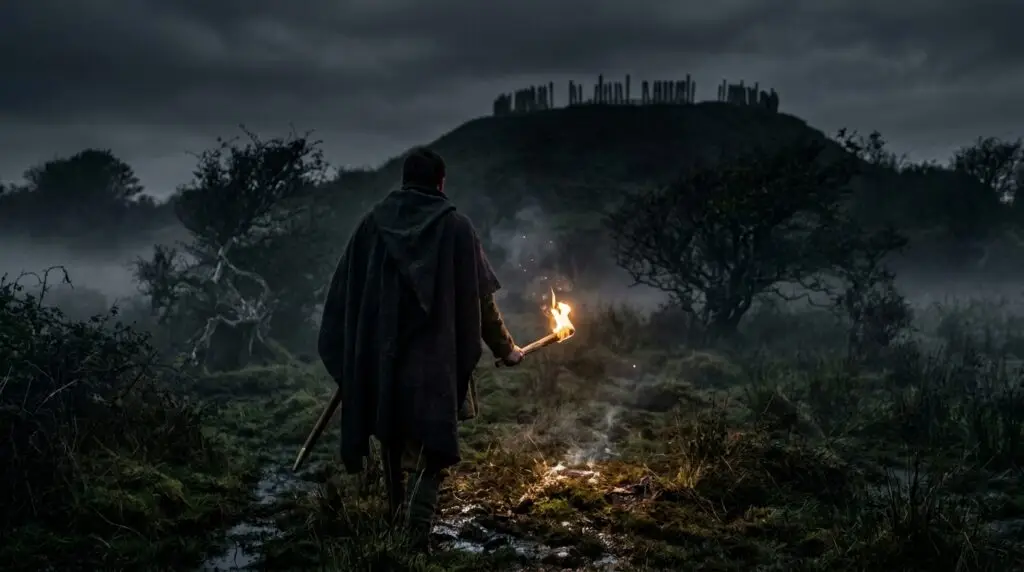
He approaches the gallows & tries fastening the loop around the dead man’s ankle.
It slips away.
He tries again.
The loop refuses to stay in place.
And then the corpse speaks.
The dead man tells Nera how to secure it properly.
Now, I don’t know about you, but if a corpse suddenly started giving me instructions, I’d probably reconsider my evening plans.
Nera, however, is apparently made of sterner stuff.
He completes the challenge.
Unfortunately, the corpse has another request.
He’s thirsty.
Would Nera mind carrying him to a nearby house for a drink?
Remarkably, Nera agrees.
With the dead man on his back, he approaches a house surrounded by fire. They cannot enter.
At another house, water blocks their way.
Finally, they reach a third home where the corpse finds something to drink.
But this is no harmless visit.
After drinking, the dead man spits into the faces of the inhabitants, killing them.
Nera eventually returns the corpse to the gallows & heads back toward the royal fortress.
Except the fortress is no longer as he left it.
Rathcroghan lies in ruins.
Its buildings are burning. Its inhabitants have been slaughtered. A supernatural army is departing with the heads of the dead.
Nera follows the army into the cave of Cruachan.
There, he enters the Otherworld.
Within this extraordinary realm, Nera encounters its inhabitants & stays with a woman who eventually reveals something astonishing.
The destruction he witnessed has not happened.
It is a vision of what could happen at the following Samhain unless he returns to warn his people.
And when Nera finally does return?
The people he left behind are still gathered around the same fire.
He has experienced three days in the Otherworld.
For them, no time has passed.
He even brings back flowers & plants associated with summer to prove where he has been, though it is Samhain in the ordinary world.
The tale continues beyond this first encounter, but that journey alone tells us something fascinating.
Samhain was not merely a convenient date for a supernatural adventure. In medieval Irish storytelling, it could be the setting for moments when the familiar world became unreliable.
The dead spoke. Hidden places opened. A possible future appeared before it happened.
And time itself refused to behave.
Of course, The Adventure of Nera, or Echtra Nerai, is a mythological tale preserved in medieval literature, not a historical eyewitness account. But it offers a remarkable glimpse into the stories through which Samhain acquired its mysterious associations.
And those stories become even more interesting when we consider what Samhain meant to the people who celebrated it.
Before the Mystery, There Was Winter
For communities living in an agricultural world, winter was more than an excuse to bring out warmer clothing.
It was a serious change in how people lived.
Animals had to be sheltered or managed for the colder months. Food needed to be gathered & preserved. The success of the harvest influenced what a household could expect in the season ahead.
In the traditional Irish seasonal calendar, Samhain marked the beginning of winter.
The year was often understood in two great halves, with Beltane opening the warmer season in May & Samhain beginning the colder season in November.
Medieval Irish literature, including The Wooing of Emer, reflects this division.
There’s something worth appreciating about that distinction.
Most of us today think of winter beginning around December 21, when the winter solstice occurs in the Northern Hemisphere.
But Samhain belongs to an older seasonal understanding shaped by climate, farming, livestock & daily life.
By early November, the harvest was largely complete. The growing season had drawn to a close. Communities were preparing for shorter days & colder weather.
The transition was significant enough to become a festival.
And where people gather, feast, exchange stories & confront uncertainty, folklore has a remarkable way of flourishing.
The Otherworld Wasn’t Necessarily a Friendly Place
If you’ve explored modern witchcraft, you’ve probably heard that the veil between the living & the dead becomes thinner at Samhain.
It’s an evocative idea, one that many contemporary practitioners find spiritually meaningful.
But it’s worth looking at the older traditions behind it.
The Irish Otherworld wasn’t simply a place where deceased relatives waited to deliver comforting messages.
It was a mysterious realm associated with supernatural beings, extraordinary places, beauty, danger & experiences beyond ordinary human understanding.
Among its inhabitants were beings associated with the sí, the supernatural dwellings or mounds found throughout Irish folklore.
The Aos Sí, sometimes described in English as fairy beings, were not necessarily the tiny, winged creatures familiar from children’s stories.
They could be powerful, unpredictable & deserving of considerable respect.
Encounters with the Otherworld might bring extraordinary gifts, strange knowledge or serious trouble.
And Samhain became an especially significant setting for such encounters in Irish literature.
This helps explain why the festival retains such a powerful reputation in witchcraft today.
But we should be careful with the history.
We cannot establish that every ancient Celtic community shared one universal belief about Samhain or that everyone understood the boundary between worlds in precisely the same way.
Much of our evidence comes from medieval literature & folklore recorded many centuries later.
Those traditions are valuable. They simply aren’t the same thing as a complete account of pre-Christian religious practice.
The popular language of the veil growing thin is a useful modern way of describing the theme, but it shouldn’t be mistaken for a precisely documented ancient doctrine.
Personally, I find the older stories fascinating enough without needing to make them more historically certain than they are.
A talking corpse & an entrance to the Otherworld are already quite a lot to work with.
When the Dead Were Expected Home
Not every Samhain tradition involves a warrior stumbling into an enchanted realm.
Some are much closer to home.
The National Museum of Ireland records Halloween customs in which the souls of the dead were believed to return to the family household.
The evening was associated with feasting, games, disguises, protective customs & divination.
In some communities, wandering spirits were considered dangerous enough that traveling alone after dark was discouraged.
Special protective crosses might be placed above doors. Masks could frighten or surprise neighbors. Young people played games intended to reveal something about future marriage or romance.
These customs reveal a festival that held several different experiences at once.
There was celebration.
There was apprehension.
There was curiosity about the future.
And there was remembrance.
Consider the difference between simply thinking about a departed loved one & living within a tradition where that person’s return might be considered possible.
An empty place at a table could carry an entirely different emotional weight.
A familiar meal might become an act of hospitality.
The household itself could become a place where the living & the remembered seemed to draw near.
For contemporary witches, these traditions offer a meaningful connection to ancestor work, remembrance & spiritual hospitality.
But they also invite something less supernatural & perhaps equally powerful.
Storytelling.
Because whether or not we believe the dead return, we know that memories do.
Sometimes through a photograph.
Sometimes through a recipe.
And sometimes through a story that begins, “Do you remember when…?”
How Did Samhain Become Halloween?
If you’ve ever seen an old Irish carved-turnip lantern, you may have a new appreciation for the cheerful pumpkins decorating American porches.
Some of those turnips are genuinely unsettling.
Long before pumpkins became the familiar face of Halloween in North America, people in Ireland carved frightening faces into turnips.
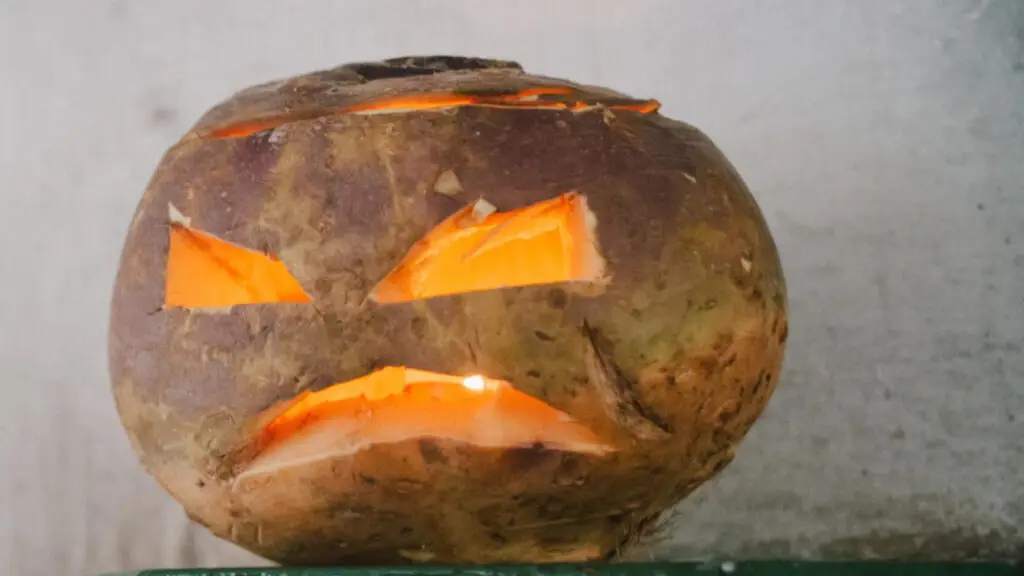
Lanterns were among the customs that traveled & changed as Irish communities settled elsewhere.
Pumpkins, being larger & generally easier to carve, eventually became the preferred material in North America.
And that is only one example of how Halloween developed.
Traditional Samhain is associated with November 1, with much of the celebration occurring on the preceding evening, October 31.
The Christian feast of All Saints also became associated with November 1, making October 31 All Hallows’ Eve, from which the English word Halloween developed.
Across centuries, Christian observances, regional customs, Irish folklore & other influences became intertwined.
The relationship is complicated.
It’s tempting to describe Halloween as nothing more than an ancient Pagan festival renamed by Christianity.
But that simplifies a long history of religious, cultural & social change.
The more interesting story is how traditions evolved, traveled & acquired new meanings.
Divination games became party activities.
Turnips became pumpkins.
Supernatural fears became ghost stories, costumes & seasonal entertainment.
And Samhain continued to hold spiritual significance for those who observed it as a seasonal festival.
But there’s another development in Samhain’s story that is considerably more recent.
And this one involves astronomy.
Wait… Isn’t Samhain Actually November 7?
Here’s a little surprise.
While Samhain is traditionally celebrated from October 31 into November 1, some modern witches observe it about a week later.
And they’re not simply choosing a more convenient weekend.
They’re following the Sun.
You see, Samhain falls between the autumn equinox & winter solstice. In the modern Wheel of the Year, it’s one of four celebrations known as cross-quarter festivals, marking points between the solstices & equinoxes.
When astronomers measure the Sun’s apparent journey through the year, they can identify the exact halfway point between the autumn equinox & winter solstice by its position along that path.
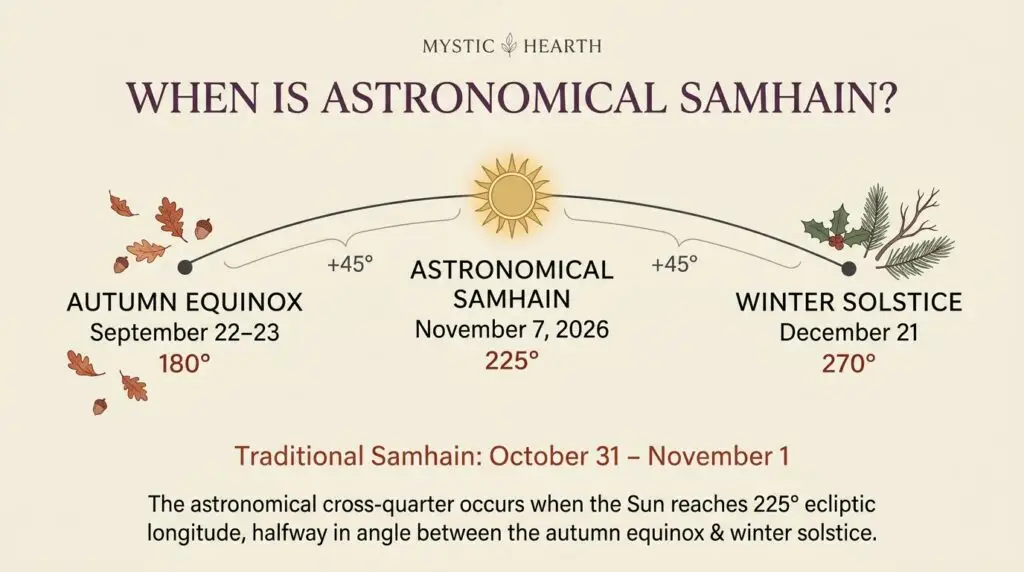
That point occurs when the Sun reaches 225° of ecliptic longitude.
In the tropical zodiac, that’s also 15° Scorpio.
In 2026, that happens on November 7.
There’s another way to calculate halfway, using the actual time between the equinox & solstice, which gives us November 6 instead. The difference exists because Earth doesn’t travel around the Sun at a constant speed.
A little celestial mathematics & suddenly Samhain has three dates worth discussing!
But does this mean October 31 is somehow wrong?
Not at all.
October 31 into November 1 is the traditional observance. November 7 is the modern astronomical cross-quarter date for 2026.
We have no reliable evidence that ancient Irish communities determined Samhain by calculating the Sun’s precise ecliptic longitude. That interpretation belongs to contemporary seasonal practice.
So whether you observe Samhain on the traditional date, follow the astronomical turning point or honor the days between them, there’s room for your practice.
The calendar tells us when to gather.
The Sun tells us where we are in the season.
And what we choose to do with that moment is entirely our own.
What Does Samhain Mean for a Modern Witch?
So what do we do with all of this?
We’ve encountered a talking corpse, an unpredictable Otherworld, centuries of Irish tradition & a small astronomical complication.
But beneath those fascinating details lies something that continues to resonate.
Samhain asks us to pay attention to endings.
Not necessarily dramatic or tragic endings.
Sometimes it’s simply the recognition that another year has changed us.
Someone we loved may no longer be here.
A relationship may have taken a different shape.
An old belief may no longer fit.
Something we once considered permanent may have quietly become part of the past.
In a culture that constantly encourages us to keep growing, producing & pushing forward, Samhain offers another perspective.
The natural world has periods when growth slows.
Leaves fall.
Fields rest.
Much of what sustains life becomes less visible.
For many practitioners, the season creates space for remembrance, divination, ancestor work & reflection.
If you’re interested in bringing intention into everyday practice, you might also enjoy exploring how symbolic ritual connects with meaningful action.
Some understand these practices as communion with spirits or deities.
Others approach them symbolically, through meditation, nature observation or personal remembrance.
And many occupy a space somewhere between those approaches.
If you’re new to Samhain, you don’t need to settle every question about spirituality before participating in a meaningful way.
You can begin with something small.
Five Small Acts of Reverence for Samhain
One of the most meaningful things about ritual is that it can transform an ordinary action through attention & intention.
A candle becomes remembrance.
A meal becomes a story.
A walk becomes a conversation with the changing season.
These five practices draw inspiration from Samhain’s historical themes, but they’re offered as contemporary personal observances rather than exact reconstructions of ancient ceremonies.
1. Speak a Name Into the Candlelight
Light a candle or switch on an LED candle.
Think of someone whose memory deserves a moment of attention.
Speak their name aloud, if you wish.
Remember one specific detail about them.
Their laugh. Their favorite saying. Something they taught you. A time when they made you feel understood.
You might simply say:
Your name is remembered. Your story remains part of mine.
Stay with the memory for a moment.
There’s nothing else you need to accomplish.
2. Make a Meal That Tells a Story
Food & feasting have long been part of Irish Halloween customs.
Prepare a dish connected to someone you remember or a tradition you value.
Perhaps it’s a family recipe.
Perhaps it’s a meal shared with someone who is no longer living.
Perhaps it’s something meaningful to your chosen family.
While preparing or sharing the food, tell the story associated with it.
Sometimes remembrance tastes like a familiar meal.
3. Give the Season Your Attention
Take a short walk, sit outside or look through a window.
Notice what has changed.
Are the trees bare?
Which plants have gone to seed?
What sounds have disappeared since summer?
What does the air feel like?
Consider what the season is doing without needing to assign a message to every observation.
Then ask yourself:
What is changing in my own life that I haven’t fully acknowledged?
4. Leave a Place for Someone Remembered
Set a small, empty place at your table.
It may hold a photograph, a keepsake or simply an empty cup.
Let it represent someone whose life still matters to you.
You might tell a story about them, offer a moment of gratitude or sit quietly with whatever feelings arise.
This practice takes inspiration from traditions of remembrance & hospitality toward the dead.
It can be spiritual, symbolic or both.
5. Ask the Coming Winter a Question
Samhain has historical connections to divination, including traditional games intended to reveal aspects of the future.
You can approach that theme through your own practice.
Draw a Tarot or Oracle card, use another form of divination or spend a few minutes journaling.
Consider the question:
What deserves my attention as I enter the darker season?
Notice what arises.
You don’t have to treat every impression as a prediction. Sometimes an honest question is enough to reveal something important about the present.
Choose one of these practices, combine several or make them your own.
And if you’d like to create a more intentional evening of remembrance, there’s a ritual I’d like to share.
A Samhain Ritual: A Place at the Hearth
One of the traditions I find particularly moving is the idea of making room for those who came before us.
A place at the table.
A story remembered.
A gesture of hospitality toward someone no longer physically present.
This contemporary Samhain ritual is inspired by those themes.
You may approach it as an act of spiritual communion, a symbolic remembrance or a personal ceremony honoring the passage of time.
What You’ll Need
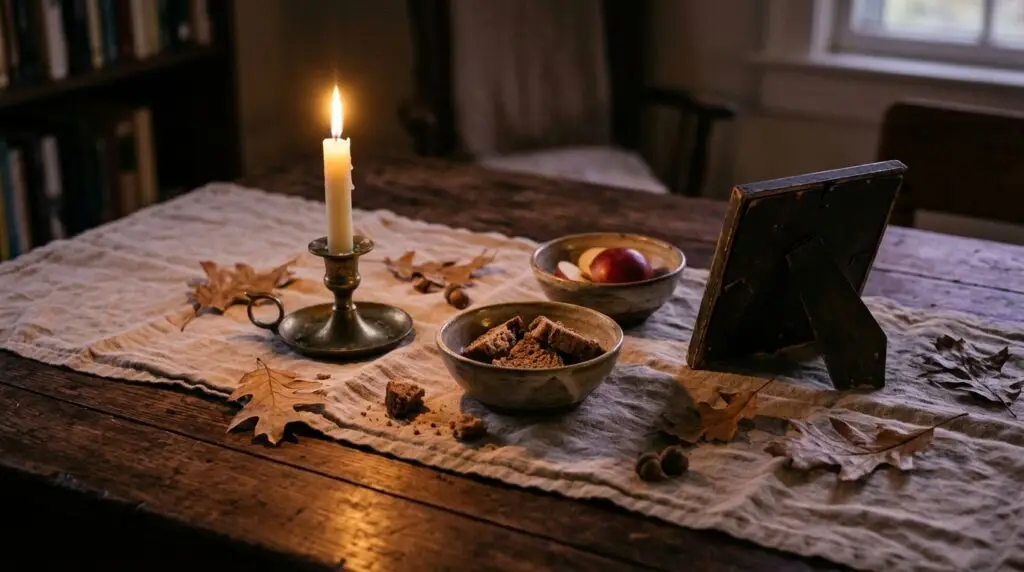
- A candle in a fire-safe holder, or an LED candle
- Two small cups, bowls or dishes
- A little food or drink, such as bread, apple, tea or water
- A photograph, keepsake or name written on paper, if desired
- A quiet place where you feel comfortable
One dish represents your place among the living.
The other represents someone you choose to remember.
Step 1: Prepare the Hearth
Arrange the two dishes on a table, placing a small portion of food or drink in each.
Set your candle nearby, keeping it safely away from decorations.
Place the photograph or keepsake beside the second dish.
Think about the person you’ve chosen to honor.
It may be a departed relative, friend, mentor or member of your chosen family.
If no particular person comes to mind, you might dedicate the space to those whose lives helped shape yours.
There’s no need to honor people who harmed you or to manufacture gratitude for painful experiences.
Step 2: Kindle the Flame
Light your candle or activate your LED candle.
Take a moment to settle into the space.
Then speak aloud or silently:
At the turning of the season, I kindle this flame.
For the living, may there be warmth.
For the remembered, may there be honor.
For the mysteries beyond my knowing, may there be respect.
This hearth is a place of peace.
Step 3: Tell Their Story
This is the heart of the ritual.
Think of a story about the person you’ve chosen to remember.
It doesn’t need to be profound.
In fact, the smallest details may be the most meaningful.
Something funny they did.
A song they loved.
A conversation you wish you could have again.
Speak the memory aloud if you feel comfortable.
Or simply allow yourself to remember.
Grief may arise.
So might laughter, affection, anger or a mixture of feelings you can’t easily name.
You don’t need to change those feelings.
Give them room.
Step 4: Offer Hospitality
Turn toward the second dish.
Consider what an offering means within your personal practice.
For some, it’s a spiritual gesture toward the departed.
For others, it’s a physical expression of remembrance.
You might say:
For those whose lives have touched mine,
I offer this moment of remembrance.
May the love worth carrying remain.
May the stories worth telling continue.
May the wisdom of the past help guide the living.
Remain quiet for a few moments.
There’s no need to summon a spirit, demand a response or interpret every sensation as a sign.
The offering itself can be complete.
Step 5: Listen to the Season Ahead
Before closing, turn your attention toward your own life.
Ask:
What am I carrying into winter that deserves my care?
Perhaps it’s a relationship.
A creative project.
An unresolved feeling.
A need for rest.
Or something you’re finally ready to release.
If Tarot or Oracle cards are part of your practice, you may draw one for reflection.
Otherwise, simply sit with the question.
You don’t need to find an immediate answer.
Step 6: Close the Hearth
When you’re ready, say:
To those I have remembered, thank you.
To the life I am living, I return.
To the season ahead, I offer my attention.
May this hearth remain a place of warmth.
May what matters continue to be remembered.
Extinguish your candle or switch off the LED light.
Enjoy your own food or drink if you wish. Dispose of the symbolic offering appropriately, without leaving food outdoors where it could harm animals.
Keep your photograph or keepsake somewhere meaningful.
Your ritual is complete.
Candle safety: Always use a stable, fire-safe holder, keep flammable objects away from the flame & never leave a candle unattended. An LED candle is an equally suitable option for this ritual.
A Few Questions Before Your First Samhain
Do I need to work with spirits or ancestors?
No. Some Samhain traditions & contemporary practices involve spirit communication or ancestor veneration, but others focus on seasonal reflection, storytelling, remembrance or divination.
You can honor someone’s memory without attempting contact with their spirit.
Do I need an altar or special ritual tools?
Not for a personal seasonal observance. You can begin with a candle, a journal, a meaningful object or simply a few minutes of reflection.
If you later choose to study a particular spiritual tradition, you can learn its specific practices & expectations.
Is Samhain October 31, November 1 or November 7?
Traditional Samhain is associated with November 1, beginning on the preceding evening. Some modern practitioners also recognize the astronomical cross-quarter, which falls around November 7 in 2026.
The dates represent different ways of marking the seasonal transition.
And When the Night Is Over?
I keep coming back to the idea of those old stories being told beside a fire.
A man meets a talking corpse.
A familiar fortress vanishes into destruction.
A cave opens into another world.
And somewhere, the people he left behind are still sitting around their fire, unaware that anything extraordinary has happened.
Centuries later, we can study the literature, examine the historical customs & calculate the Sun’s position with extraordinary precision.
But I wonder whether the enduring fascination of Samhain comes from something much simpler.
We still want to understand what happens when life changes.
We still wonder about the people we’ve lost.
We still carry stories that deserve to be remembered.
And every year, the darker season arrives, inviting us to consider what we’re carrying forward.
You might mark Samhain with an elaborate ceremony.
You might prepare a meal, draw a card or light a candle.
Or you might simply speak a name into the quiet.
This Samhain, whose story deserves to be told at your hearth?
I’d love to hear how you observe the season, what traditions you’ve inherited or what you’re still curious about.
At Mystic Hearth, there’s room for the experienced practitioner, the curious beginner & everyone still discovering what their spiritual path means.
Continue the conversation inside Voices of Flame. Enter the Circle.