
You’ve gathered your herbs, chosen a candle & written down your intention. You’re ready to begin.
But what exactly are you about to do?
Are you casting a spell? Performing a ritual? Does lighting a candle make something a ritual? Does a ritual need a spell to be complete?
And perhaps the question quietly troubling many new witches:
Am I doing this correctly?
If you’ve wondered about any of these things, you’re asking worthwhile questions.
Witchcraft introduces us to a rich variety of practices, traditions & techniques. Unfortunately, the language surrounding them isn’t always explained clearly.
You’ll find books describing elaborate spell rituals, videos demonstrating simple candle spells & practitioners using the words spellwork and ritual almost interchangeably.
It’s understandable that the distinction can become confusing.
But there is a useful difference between spell crafting & ritual crafting. Understanding it can help you make more thoughtful choices, recognize why particular actions matter & eventually design magickal workings that reflect your own spiritual practice.
And here’s something worth knowing from the beginning:
You don’t need to master elaborate ceremonies before you can begin creating meaningful magick.
You need to understand what you’re trying to accomplish & why you’re choosing the actions you take.
What Is Spellwork?
Spellwork is the practice of directing magickal action toward a particular intention, purpose, or desired outcome.
That outcome might involve something in your circumstances, such as welcoming new opportunities or establishing protection around your home.
It might also involve a personal change, such as strengthening your confidence, developing clarity, or releasing an unwanted habit.
Some familiar examples include:
- A protection spell focused on establishing or reinforcing boundaries.
- A prosperity spell intended to welcome financial opportunities.
- A self-love spell supporting a kinder relationship with yourself.
- A banishing spell intended to release an unwanted influence.
- A clarity spell focused on approaching an important decision.
Each begins with a similar question:
What am I seeking to create, change, invite, protect, or release?
How a witch understands the magick involved depends on their beliefs & tradition.
Some practitioners understand spells as ways of working with spiritual forces, relationships, or unseen influences. Others work through prayer, symbolism, intention, ancestral relationships, or methods taught within established traditions.
Some also value the ways magickal practice can focus attention, reinforce commitments & influence personal behavior.
These understandings aren’t necessarily interchangeable. No single explanation represents every form of witchcraft.
For our purposes, the defining feature of spellwork is its focus on a particular magickal intention.
What Can a Spell Look Like?
A spell might involve spoken words, a carefully chosen object, a symbolic action, a written petition, or materials associated with the intention.
Consider a witch creating a protective charm.
They might choose a small key to represent their boundaries, speak words expressing their intention & keep the key somewhere meaningful.
Another witch might approach protection through prayer or a traditional method learned from their community.
Both may consider their actions spellwork, even though the methods & spiritual understandings differ.
A spell doesn’t need to be elaborate to be complete. Nor does simplicity automatically make one more effective.
What matters is that the practitioner understands the relationship between the purpose, method & chosen actions.
What Is Ritual Work?
Ritual work involves a meaningful sequence of intentional actions designed to honor a purpose, create a spiritual experience, deepen a relationship, or mark a transformation.
Rituals exist in many religious, cultural, community & personal settings. They are not exclusive to witchcraft.
Within witchcraft, a ritual might honor the changing seasons, celebrate a milestone, remember an ancestor, deepen a devotional relationship, or mark the ending of one chapter of life & the beginning of another.
A ritual may also provide space for contemplation, spiritual connection, gratitude, or renewal.
Imagine lighting a candle on the anniversary of a loved one’s death.
You sit quietly, speak their name, remember a favorite moment & offer gratitude for their presence in your life.
You’re not necessarily attempting to attract, banish, or magickally change anything.
You’re creating an intentional experience of remembrance.
That can be a complete ritual without including a spell.
Of course, rituals can also contain magickal workings directed toward particular outcomes.
Some traditions don’t separate spellwork & ritual in the way we’re describing here. Within those traditions, magickal workings may themselves be understood as rituals.
The distinction we’re exploring is a useful learning framework, not a universal rule governing every witchcraft tradition.
Spellwork vs. Ritual: Understanding the Key Differences
The difference between spells & rituals becomes easier to understand when we consider what each is primarily designed to accomplish.
| Consideration | Spellwork | Ritual Work |
| Primary purpose | Direct magickal action toward an intention or outcome | Honor a purpose, create a meaningful experience, or mark a transformation |
| Structure | Organized around the needs of the magickal working | Organized around the progression of an experience |
| Central question | What am I seeking to create, change, invite, protect, or release? | What am I honoring, experiencing, or marking? |
| Possible actions | Spoken words, charms, symbolic gestures, petitions, offerings, or other magickal methods | Reflection, prayer, offerings, meditation, movement, spellwork, or other intentional actions |
| Experience or outcome | May seek a specific change while also holding spiritual or personal meaning | May be meaningful through participation itself, with or without a desired change |
| Relationship | Can stand alone or be included within a ritual | Can stand alone or contain one or more spells |
These are tendencies rather than rigid boundaries.
A spell can be deeply ceremonial. A ritual can have a specific desired outcome. Both may involve spiritual relationships, meaningful symbolism, careful preparation & deliberate action.
Neither is inherently more powerful, advanced, or spiritually legitimate.
The most useful question may be:
Am I designing a focused magickal working, a meaningful spiritual experience, or a combination of both?
How Spells & Rituals Work Together
Let’s explore the distinction through an intention many people can relate to: developing greater confidence & self-trust.
Perhaps you’ve spent years second-guessing yourself.
You hesitate to share your ideas, question your decisions or struggle to recognize your strengths.
You’re ready to change that relationship with yourself.
There are several ways to approach this intention through magickal practice.
Approach One: A Standalone Confidence Spell
You decide to create a spell focused on strengthening self-trust.
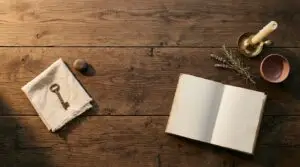
You choose a small key to symbolize your ability to make decisions about your own life.
Holding the key, you speak:
“My voice holds value. My choices are mine to make.”
You pause, focus on the intention & place the key somewhere you’ll encounter it during your day.
You acknowledge that the working is complete.
The spell has a particular focus: supporting your intention to develop confidence.
It doesn’t require a larger ceremony around it.
Approach Two: A Ritual for Reclaiming Self-Trust
Instead, perhaps you want to spend time exploring your relationship with confidence.
You set aside a quiet period for reflection.
You begin by acknowledging that you’re creating space to consider your personal growth.
You think about moments when you doubted yourself & where some of those expectations originated.
You reflect on the strengths you’ve developed, the experiences that shaped you & what you want your relationship with yourself to become.
You close by naming one small way you intend to honor your own judgment.
There is no separate spell directed toward changing an outcome.
The purpose is to recognize your experience & consciously mark a shift in how you wish to treat yourself.
Approach Three: A Ritual That Incorporates a Spell
You could also combine these approaches.
You begin with the reflective ritual, acknowledging your experiences & exploring what confidence means to you.
At the center of that experience, you perform the key spell as a focused magickal working.
Afterward, you consider how you’ll carry that intention into everyday life.
Perhaps you decide to contribute an idea during tomorrow’s meeting or make a small decision without immediately seeking reassurance.
You close the ritual with gratitude for what you’ve recognized.
Here, the spell serves as one meaningful part of a larger spiritual experience.
All three approaches can be complete & worthwhile. They simply organize the intention differently.
And none replaces the value of practical action in your everyday life.
Understanding the Structure of a Spell
Once you recognize the purpose of spellwork, a natural question follows:
How do you begin designing a spell of your own?
You could start by collecting ingredients from a recipe. But without understanding why those ingredients or actions were chosen, you may find yourself depending on instructions you don’t fully understand.
Learning to craft spells involves examining the decisions behind the working.
At Mystic Hearth, we use six guiding considerations to help organize that thinking.
These aren’t six mandatory physical steps or a replacement for the methods of an established tradition.
They’re a flexible framework for understanding the choices involved in spell crafting.
1. Purpose: What Am I Seeking?
Begin with your intention.
What are you hoping to create, change, invite, protect, or release?
Try to understand what your intention means to you.
For example, “I want prosperity” might mean welcoming opportunities, developing financial stability or improving your relationship with money.
The clearer your purpose, the easier it becomes to make meaningful choices.
2. Approach: What Guides My Understanding?
Consider the spiritual or magickal understanding behind your working.
Are you approaching magick through prayer, intention, symbolism, spiritual relationships, a traditional method, or another understanding?
You don’t have to explain every mystery of magick.
But you should consider whether your chosen methods fit your beliefs, values & any tradition you’re practicing.
3. Meaning: Why Am I Choosing These Symbols or Materials?
This is where correspondences become important.
A correspondence is an association between something, such as a plant, color, number, object, or symbol, and a particular meaning or purpose.
These associations may come from historical traditions, folklore, contemporary magickal systems, or personal experience.
They aren’t universal laws.
For example, yellow is associated with sunlight, optimism & confidence in some modern correspondence systems.
But perhaps yellow reminds you of anxiety rather than confidence.
That doesn’t automatically invalidate a tradition’s established correspondences. It does invite you to understand the context of the association & decide what is appropriate for the working you’re creating.
Understanding why you’ve chosen something matters more than gathering a collection of supposedly correct ingredients.
4. Action: What Will I Actually Do?
Now consider how you’ll express your intention.
Will you speak words, tie a knot, create a charm, write something down, make an offering, or perform another meaningful action?
Think about how the action relates to your purpose & approach.
Also consider practical matters such as safety, accessibility, consent & respect for spiritual or cultural boundaries.
5. Completion: How Will I Close the Working?
A recognizable ending helps establish that the working is complete.
You might speak closing words, put away materials, offer thanks or follow an established closing method within your tradition.
Completion doesn’t need to be dramatic.
It simply provides an appropriate end to what you’ve undertaken.
6. Reflection: What Did I Experience or Learn?
Afterward, consider what the experience taught you.
Did your chosen actions make sense? Were they consistent with your intention? Would you approach anything differently next time?
You might also observe developments related to your intention over time, without assuming that every coincidence proves a magickal cause.
Reflection allows your understanding to grow through experience.
These six considerations — Purpose, Approach, Meaning, Action, Completion & Reflection — provide a foundation for crafting spells thoughtfully.
They’re questions to consider, not a checklist you must physically perform in order.
Understanding the Structure of a Ritual
Ritual crafting asks you to think about the experience you’re creating.
Rather than focusing primarily on one magickal working, you’re considering how a meaningful sequence of actions can express a particular spiritual purpose.
A ritual might last a few minutes or several hours. It might be solitary, shared with others, highly ceremonial or beautifully simple.
Mystic Hearth’s ritual-crafting framework includes six adaptable considerations.
1. Purpose & Context: What Am I Honoring?
Begin by identifying why the ritual matters.
Are you celebrating a seasonal transition, honoring a spiritual relationship, acknowledging grief, marking personal growth or expressing gratitude?
Consider the context that gives the experience meaning.
2. Preparation: What Will Support the Experience?
Think about what you need to participate meaningfully.
Perhaps you’ll prepare a comfortable space, gather significant objects, research a traditional observance or make time without interruptions.
Preparation should support the ritual’s purpose rather than become an obstacle.
3. Opening: How Will I Intentionally Begin?
An opening marks the transition into deliberate ritual participation.
Some practitioners use formal prayers, invocations, gestures or ceremonial methods.
Others begin with a moment of quiet acknowledgment.
The appropriate opening depends on your beliefs, traditions & purpose.
4. Central Experience: What Meaningful Actions Will Take Place?
This is the heart of the ritual.
You might reflect, meditate, sing, make offerings, practice devotion, engage in symbolic movement or perform a spell.
Consider why each activity belongs.
You don’t need to fill every moment with action. Silence & observation may be meaningful parts of the experience.
5. Closing: How Will I Conclude?
A closing brings the ritual to an intentional end.
Depending on your practice, it might involve gratitude, a farewell, a formal ceremonial action or a simple acknowledgment of completion.
If you’ve invited spiritual participation according to a particular tradition, its established closing practices may also matter.
6. Integration: What Will I Carry Forward?
Integration considers how the experience connects to your everyday life.
Perhaps a ritual of remembrance inspires you to preserve a family story.
A seasonal observance might encourage you to spend more time noticing the natural world.
A ritual marking personal growth might help you identify a new commitment.
Not every ritual produces a profound revelation.
Sometimes its significance becomes clearer with time.
These six considerations — Purpose & Context, Preparation, Opening, Central Experience, Closing & Integration — help you create a coherent, meaningful experience.
They aren’t universal ceremonial requirements.
What If I Don’t Feel Anything magickal?
Here’s something that doesn’t always receive enough attention in beginner witchcraft discussions.
You can plan a thoughtful spell, perform every action you intended & finish without feeling anything particularly unusual.
No tingling sensation. No dramatic spiritual presence. No sudden moment of certainty.
You might simply feel calm.
You might feel distracted.
You might not notice anything different at all.
Some practitioners describe powerful emotional, physical or spiritual experiences during magickal workings. Others describe quiet contemplation.
Those experiences can be personally meaningful, but dramatic sensations alone don’t establish whether magick has occurred or whether a working has achieved its intended purpose.
And an ordinary experience doesn’t automatically mean you’ve done something incorrectly.
The same is true of ritual.
A remembrance ritual might bring tears one day & quiet reflection another.
Its meaning doesn’t have to depend on producing a particular feeling.
You may also stumble over a word, forget an action or discover that something you planned doesn’t work quite as expected.
Within established traditions, specific procedures may be important. But when you’re designing a personal working, you can evaluate what happened & decide whether to adapt, continue or begin again another time.
Presence matters more than performance for the personal practices we’re exploring here.
You don’t have to manufacture a mystical experience to prove you belong in witchcraft.
Finding Your Own Approach to magickal Crafting
One of the challenges of learning witchcraft today is the enormous amount of information available.
You’ll encounter books, videos, correspondence charts, traditional teachings & personal methods presented with varying degrees of certainty.
Some instructions come from established traditions with particular spiritual, cultural or ceremonial significance.
Others reflect contemporary interpretations or the experiences of individual practitioners.
Learning to recognize those differences is part of developing spiritual discernment.
Ask where a method originates. Consider why particular symbols are used. Be willing to research unfamiliar practices before incorporating them into your own.
And recognize that some practices have cultural, religious or initiatory boundaries that deserve respect.
Finding your own approach doesn’t mean taking whatever appeals to you from every tradition.
It means developing a practice informed by understanding, thoughtful choices & respect for others.
It also means recognizing that magickal supplies aren’t a substitute for spiritual understanding.
A simple working can be meaningful when its actions are thoughtfully chosen. A complex ritual can be meaningful when its structure belongs to a particular purpose or tradition.
Neither complexity nor simplicity automatically establishes spiritual power.
And while magickal practice may hold deep spiritual significance, it doesn’t replace practical responsibility, consent, professional care or action in the everyday world.
Your understanding will continue developing.
You may discover traditions you want to study more deeply, spiritual relationships you wish to explore, or personal methods that become meaningful through continued practice.
You don’t need to settle every question today.
You can begin with curiosity & let knowledge inform the choices that follow.
A Simple Practice: One Purpose, Three Possibilities
Let’s bring what you’ve learned into something you can use.
Choose one intention or spiritual purpose that matters to you right now.
It could involve protection, confidence, gratitude, clarity, remembrance or an approaching life transition.
Then consider these questions:
1. What am I actually seeking?
Is there a particular change you’re hoping to encourage, something you want to honor, or an experience you want to create?
2. What might a standalone spell look like?
Think of one meaningful action that could express your intention. What would you choose & why?
3. What might a standalone ritual look like?
Imagine creating a brief experience around your purpose. How would you begin, what would happen at its center & how would you close?
4. Would combining them serve your purpose?
Would including a focused spell within a broader ritual add something meaningful, or would one approach be enough?
5. What will you carry into everyday life?
Consider one practical action, reflection or commitment that supports your purpose.
You don’t need special supplies, a perfectly written incantation or an elaborate ceremony.
You don’t even need to perform the working today.
For now, begin by understanding your choices.
If you can explain what you’re seeking, why you’ve chosen an approach & how your actions express that purpose, you’ve already begun practicing the art of magickal crafting.
Learning to Craft Your Own magick
There may come a moment in your practice when you open a spellbook & notice something different.
Instead of immediately gathering the listed ingredients, you begin wondering why they were chosen.
You recognize how the actions relate to the intention.
You notice which elements come from a particular tradition & which might be personal choices.
And perhaps, for the first time, you feel capable of deciding what belongs in a working you’re creating yourself.
Something similar happens when you begin understanding ritual structure.
You no longer assume that a meaningful ceremony must be lengthy or elaborate.
You begin thinking about the experience you want to create, what gives it meaning & how its different elements work together.
That is a valuable kind of growth.
You’re moving from following instructions toward understanding the craft behind them.
Crafting Your Own magick: Where We Go From Here
This article is the foundation of Mystic Hearth’s developing Crafting Your Own magick educational collection.
Two companion resources are planned: The Spell Crafter’s Workbook & The Ritual Crafter’s Workbook.
Each will explore its respective six-part framework in greater depth, helping you develop your understanding through guided learning, examples & practical exercises.
Additional crafting worksheets are also planned to support your ongoing practice with reusable planning tools & reflection records.
These resources are still in development.
But you don’t need to wait for them to begin.
Take the intention you explored above & consider one small step toward making it real.
You might research a symbol, clarify your purpose, sketch a simple ritual or explore a question that deserves more thought.
Let your understanding grow alongside your practice.
You don’t need to create magick exactly as someone else does.
You can learn from others, respect the traditions that guide them & gradually develop a practice that reflects your own spiritual path.
Learn the structure. Understand the purpose. Create your own magick.