

There is a moment many people do not expect when they begin questioning an inherited belief system.
The belief changes.
But the fear does not.
You may no longer accept the teaching that once shaped your choices, yet still feel dread when you do something that teaching forbade.
You may intellectually reject the idea that curiosity is dangerous but feel guilty for reading about another spiritual path.
You may no longer believe that a ritual, symbol, practice or question can condemn you, yet your body may still tense as though something terrible is about to happen.
That gap can be deeply confusing.
You may wonder whether some part of you still believes the teaching after all. You may begin distrusting your own judgment—or feel pulled toward an old certainty, not because it feels true, but because certainty once felt safer than not knowing.
If you recognize yourself here, you are not failing.
Your conscious beliefs may change before the emotional patterns built around them have had time to loosen.
Lingering religious fear is the continued experience of guilt, dread or anticipated punishment after a person’s conscious beliefs have changed. The feeling may remain because repeated warnings, habits & emotional associations often take longer to change than intellectual conclusions.
The fear is real as an experience.
That does not automatically make the old warning true.
WHY FEAR CAN REMAIN AFTER A BELIEF CHANGES
Beliefs are not held only as sentences in the mind.
Over time, they can become habits, expectations, reflexes, images, rules & emotional associations.
A person may repeatedly learn:
- Questioning is dangerous.
- Doubt is disobedience.
- Curiosity opens the door to harm.
- Certain practices invite punishment.
- Discomfort means something is spiritually wrong.
- Authority should be trusted more than personal judgment.
- Making the wrong spiritual choice could have permanent consequences.
Even after someone stops agreeing with those teachings, they may still react as though the warnings remain active.
That does not necessarily mean the old belief is secretly true to them.
It may mean the warning was repeated so often that responding to it became automatic.
A message heard once may be easy to dismiss. A message reinforced for years can begin to feel like instinct.
That distinction matters.
An instinctive feeling can be powerful. It can be emotionally real. It can affect your thoughts, your body & your decisions.
But emotional intensity alone does not prove that the interpretation attached to the feeling is accurate.
FEAR IS AN EXPERIENCE, NOT ALWAYS A VERDICT
When fear appears, the mind often tries to explain it quickly.
“I feel afraid, so this must be dangerous.”
“I feel guilty, so I must be doing something wrong.”
“I feel watched, so perhaps I am being judged.”
“I feel uneasy, so perhaps this practice is spiritually unsafe.”
Sometimes fear is useful information.
It can alert us to pressure, manipulation, coercion, genuine danger or a boundary that deserves attention.
But fear can also repeat an old lesson long after the circumstances have changed.
The question is not whether the fear is real.
The fear is real because you are experiencing it.
The question is what the fear means.
That is where discernment begins.
Instead of immediately obeying the fear—or immediately dismissing it—you can pause long enough to ask:
- What does this feeling seem to be warning me about?
- Where did I first learn that warning?
- What evidence supports it now?
- What evidence challenges it?
- Is this fear responding to a present boundary or repeating an inherited rule?
- What choice would I make if I did not have to decide right now?
These questions do not force the fear away.
They create space between the feeling & the conclusion.
That space is often where personal agency begins to return.
Personal agency means recognizing that your life, beliefs, boundaries & spiritual choices belong to you. You may seek wisdom, guidance or community, but the final decision does not have to be surrendered to fear or authority.
YOU MAY GRIEVE WHAT YOU NO LONGER BELIEVE
Fear is not the only thing that may remain after a belief changes.
Grief may remain too.
A former belief system may have given structure to your life. It may have offered language for suffering, belonging, family, morality, death, hope or identity.
Even when parts of that system caused harm, leaving or changing it can create a genuine loss.
You may miss the certainty of knowing what everything meant.
You may miss familiar songs, prayers, gatherings or rituals.
You may miss the shared language of family or community.
You may miss the feeling that someone else already knew the answer.
You may even miss the version of yourself who once knew exactly where they belonged.
Grieving those things does not mean you made the wrong decision.
It means the old structure mattered.
People can grieve a place they could no longer remain.
They can miss parts of a community that did not fully accept them. They can long for certainty while recognizing that the certainty came at too great a cost.
Contradictory feelings do not make your process dishonest.
They make it human.
Changing an inherited belief also does not require rejecting every part of the tradition that once held it. You may release some teachings while continuing to value certain stories, practices, relationships or expressions of faith.
The choice does not have to be all or nothing.
OLD RULES MAY CONTINUE AS HABITS
Sometimes what remains is not dramatic fear.
It is a quiet rule operating in the background.
You may still:
- Ask permission before trusting your own experience
- Search for an authority to confirm every spiritual choice
- Feel obligated to explain or defend your curiosity
- Avoid practices that interest you because you cannot prove they are completely safe
- Believe that making a mistake is more dangerous than never beginning
- Distrust pleasure, imagination, intuition or experimentation
- Feel that every spiritual choice must become a permanent identity
These habits may have developed because they helped you avoid conflict, shame, punishment or exclusion.
They may have protected you in the environment where you learned them.
But a habit that once protected you may later restrict you.
You do not have to condemn the version of yourself who learned that habit. You can recognize why it formed, honor how it once protected you & still decide that it no longer gets to choose your path.
YOU DO NOT HAVE TO REPLACE ONE CERTAINTY WITH ANOTHER
When an inherited framework begins to fall away, the empty space can feel unbearable.
It can be tempting to fill that space quickly with a new teacher, doctrine, identity or set of rules.
Sometimes new guidance is useful. A new tradition may offer language, practice & community that genuinely support growth.
But urgency can make certainty look like safety.
A confident voice may feel trustworthy simply because it reduces ambiguity.
This is why discernment matters most when you feel desperate for an answer.
As a practical standard, trustworthy spiritual teachers should be able to tolerate sincere questions about how they reached their conclusions.
A healthy community should not treat uncertainty as failure.
A healthy practice should not require you to ignore your boundaries to prove your devotion.
A teacher or community should not become more powerful by making you feel less capable of thinking, questioning or choosing for yourself.
You are allowed to learn slowly.
You are allowed to remain undecided.
You are allowed to try a practice without building an identity around it.
You are allowed to change your mind.
You may also decide that a particular belief, practice or community does not belong in your life.
Personal agency includes the freedom to approach.
It also includes the freedom to decline.
BEGIN WITH WHAT IS ACTUALLY HAPPENING
When fear rises, it can help to begin with observation rather than interpretation.
Instead of saying:
“This is a warning.”
Try:
“My chest feels tight when I think about doing this.”
Instead of:
“I am being punished.”
Try:
“I feel guilty after considering something I was taught to avoid.”
Instead of:
“This practice is dangerous.”
Try:
“I notice that this practice activates an old fear.”
Observation does not require you to dismiss every concern.
It simply allows you to describe what is happening before deciding what the experience proves.
Interpretation often arrives already carrying the old conclusion.
Observation leaves room for more information.
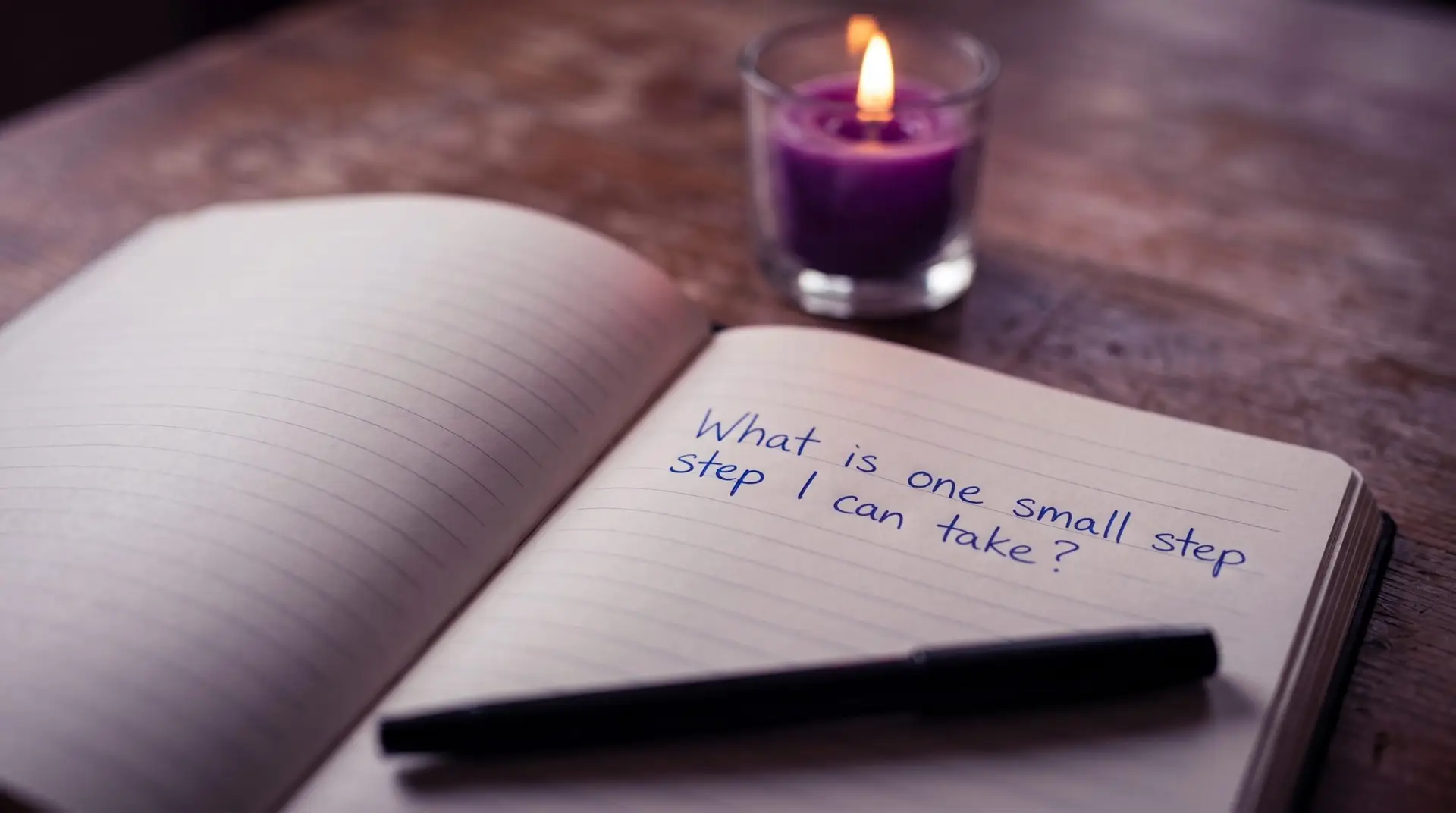
A FOUR-QUESTION REFLECTION: NAME THE WARNING
You do not need an elaborate ritual to begin this work.
Choose one fear that still appears after a belief has changed.
Write the warning as plainly as you can.
For example:
- “If I explore witchcraft, something bad will happen.”
- “If I question this teaching, I will be punished.”
- “If I trust myself, I will be led astray.”
- “If I stop believing this, I will lose everyone I love.”
- “If I make the wrong spiritual choice, I will not be able to undo it.”
Then move through these four questions.
1. Who taught me this warning?
Name the person, community, text, environment or repeated message that gave the fear its shape.
This is not necessarily about assigning blame.
It is about identifying the source.
2. What did this warning ask me to do?
Did it ask you to:
- Obey?
- Avoid?
- Remain silent?
- Distrust yourself?
- Seek permission?
- Fear curiosity?
- Separate yourself from certain people or practices?
Notice the behavior the warning expects from you.
3. What happens in me when the warning appears?
Notice your thoughts, sensations, images, urges & behaviors.
You might become tense.
You might search repeatedly for reassurance.
You might stop reading, close a page or abandon a question.
You might feel compelled to confess, apologize or reverse a decision.
You might imagine punishment.
Simply record what happens without trying to prove or disprove it.
4. What choice would support my agency now?
The answer does not have to be dramatic.
It might be:
- Wait twenty-four hours before deciding.
- Read from more than one source.
- Speak with someone who will not pressure you.
- Try a very small version of the practice.
- Decide not to proceed, but make that choice from reflection rather than panic.
- Remind yourself that uncertainty is not an emergency.
- Seek support from a qualified mental-health professional if the fear becomes overwhelming or disrupts daily life.
This reflection does not require you to prove the warning false.
It helps you stop treating the warning as the only voice allowed in the room.
Save these four questions somewhere you can return to when an old warning feels urgent.
A GROUNDED RITUAL FOR RECLAIMING CHOICE
You may choose to give this reflection a simple physical form.
This ritual is optional. The journaling practice is complete on its own.
You Will Need
- A small candle or LED candle
- A piece of paper
- A pen
- A stable, fire-safe surface if using a real flame
Write one inherited warning on the paper.
Beneath it, write:
This fear may speak, but it does not decide for me.
Light the candle or switch on the LED candle.
Read the warning once.
Then read the second sentence slowly.
Sit for a few moments & notice what arises without forcing yourself to feel calm, brave or certain.
You may fold the paper & place it near the candle while you sit.
Do not place loose paper beneath or against a burning candle.
The purpose is not to destroy the fear.
The purpose is to practice making room for the fear without handing it authority over your next choice.
When you extinguish the candle, choose one small grounded action.
That action might be reading, journaling, resting, asking a question or deciding that you need more time.
The ritual supports the choice.
It does not make the choice for you.
Candle Safety
Use a stable, fire-safe holder, keep paper, fabric, children & pets away from the flame & never leave a candle unattended. An LED candle is equally suitable.
WHAT GROWTH MAY LOOK LIKE
Growth does not always mean the fear disappears.
Sometimes growth means you notice it sooner.
You recognize whose voice the warning resembles.
You stop treating discomfort as automatic proof.
You ask for evidence.
You wait before reacting.
You make a smaller, more deliberate choice.
You allow uncertainty without immediately searching for another authority.
You respond to yourself with less shame.
You begin to recognize that feeling afraid & being in danger are not always the same thing.
The goal is not to become fearless.
The goal is to become more capable of choosing while fear is present.
MOVE AT THE SPEED OF TRUST
There is no prize for replacing your entire spiritual framework overnight.
You do not need to explore every forbidden idea.
You do not need to adopt a new label.
You do not need to prove that you are liberated by forcing yourself into practices that overwhelm you.
You are allowed to move at the speed of trust.
That may mean taking one small step.
It may mean learning more.
It may mean resting before you continue.
It may mean deciding that a particular practice does not belong in your life.
What matters is that the choice gradually becomes yours.
THE FLAME AFTER THE FIRE
Awakening is often imagined as a clean break.
One belief disappears & a new truth takes its place.
Real change is rarely that orderly.
Something old may burn away while traces of smoke remain.
You may still smell the fear long after the fire has gone out.
You may still reach for rules that no longer fit.
You may still grieve what once gave you shelter.
None of that means you are moving backward.
Becoming free of a belief is one kind of change.
Becoming able to trust your own thoughtful choices is another.
The second may take longer.
It may also be the deeper work.
CLOSING REFLECTION
What fear, habit or question has remained even after one of your beliefs changed?
You do not need to solve it today.
Begin by naming it.
Then ask:
Is this feeling offering present information or repeating an inherited warning?
What would it look like to let the fear speak without allowing it to decide?
Choose One Warning
Choose one warning that still follows you.
Write where you learned it, what it asks you to do & one small choice that would return the decision to you.
You are not required to defeat the fear.
For today, simply practice noticing it without obeying it automatically.
You Do Not Have to Untangle This Alone
Inside Voices of Flame, we are holding a gentle conversation about the fears, habits & warnings that can remain after beliefs change.
You may share what you are noticing, ask a question or simply read until you feel ready.
The purpose is not to debate whether your fear is rational.
It is to explore how inherited warnings continue shaping spiritual choices & what helps us respond with greater clarity, patience & agency.
Continue the conversation inside Voices of Flame.
Does lingering fear mean I still believe?
Not necessarily. A learned emotional reaction may remain even after your conscious beliefs have changed. The feeling deserves attention, but it does not automatically confirm the warning attached to it.
Should I always ignore spiritual fear?
No. Fear can sometimes identify pressure, manipulation, danger or a genuine boundary. The goal is to examine what the fear is responding to before treating it as proof.
Do I have to explore the things I was taught to fear?
No. Personal agency includes the freedom to explore, wait or decline. You do not have to force yourself into any belief or practice to prove that you have changed.